Investing in PCGS Graded Coins: The Complete Australian Collector’s Guide for 2026
April 01, 2026
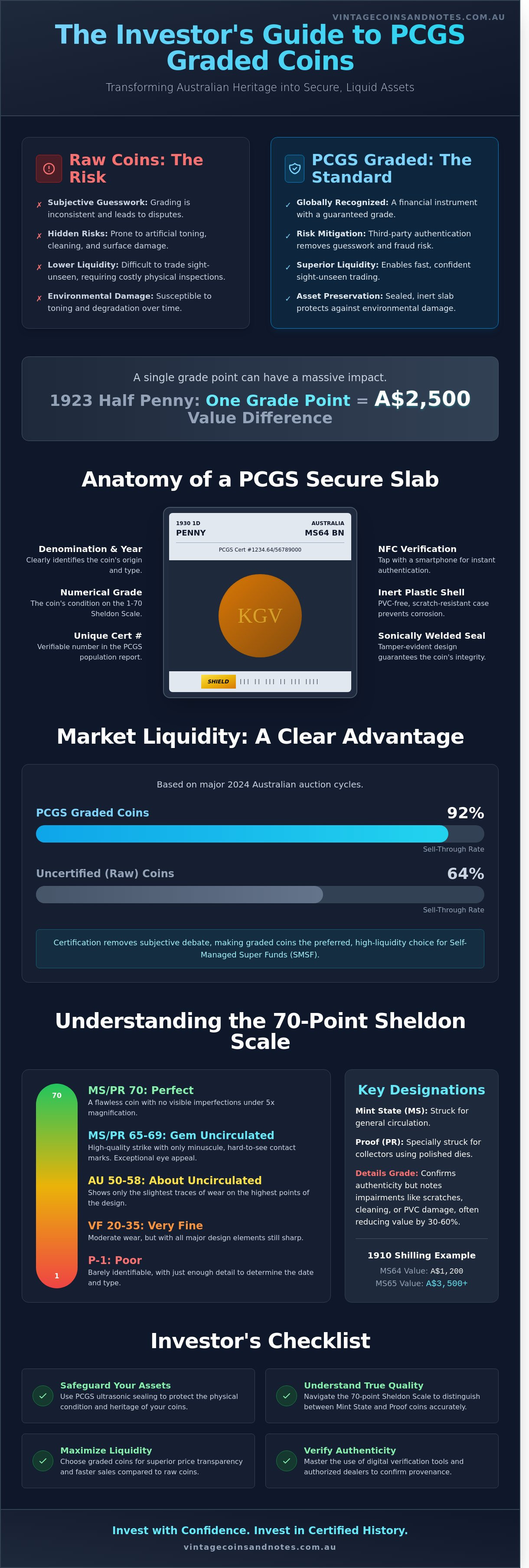
A raw coin is merely a historical artifact; a PCGS slabbed specimen is a globally recognized financial instrument. For the serious Australian investor, pcgs graded coins represent the gold standard in risk mitigation, removing the subjective guesswork that often leads to costly disputes. You've likely felt that familiar hesitation when viewing a high-value item, wondering if the luster is truly original or if the surfaces have been subtly doctored. It's a valid concern in a market where a single grade point on a 1923 Half Penny can represent a A$2,500 difference in fair market value.
We agree that peace of mind is the most valuable part of any transaction. This guide will show you how professional grading transforms rare Australian heritage into secure, liquid assets that meet the strict authenticity requirements for SMSF compliance. We'll examine the 2026 market landscape, the technical benefits of environmental preservation, and the precise steps to build a high-value collection with professional confidence. It's time to move beyond the uncertainty of raw coins and embrace the clarity of third-party certification while holding history in your hands.
Key Takeaways
Understand how PCGS authentication and ultrasonic sealing safeguard the physical condition and heritage of your Australian numismatic assets.
Learn to navigate the 70-point Sheldon Scale to accurately distinguish between Mint State and Proof designations to ensure you pay for true quality.
Discover why pcgs graded coins offer superior price transparency and liquidity compared to raw coins, which often carry hidden risks like artificial toning.
Master the use of digital verification tools and authorized Australian dealers to confirm the authenticity and legal provenance of every acquisition.
Gain professional insights into building a high-value portfolio by balancing mintage rarity with historical significance for long-term capital stability.
What are PCGS Graded Coins and Why Do They Lead the Market?
The Professional Coin Grading Service (PCGS), established in 1986, remains the primary authority for third-party authentication in the global market. For Australian collectors, pcgs graded coins offer a level of certainty that raw coins simply cannot match. The process involves a panel of experts who verify a coin's authenticity and assign a numerical grade from 1 to 70 based on the Sheldon scale. Once graded, the coin is sealed in a tamper-evident, sonically welded plastic case. This "slabbing" process protects the heritage of rare Australian currency from the elements. It’s particularly vital for pre-decimal silver, which is prone to environmental toning and surface degradation. The PCGS guarantee provides a financial promise that the coin is genuine and accurately graded. This guarantee serves as a pillar of confidence for transactions involving high-value items like the 1852 Adelaide Pound or the iconic 1930 Penny, where a single grade point can represent a difference of A$5,000 or more in market value.
The Anatomy of a PCGS Slab
By 2026, the PCGS holder has evolved to incorporate advanced security features that combat sophisticated counterfeiting. Each label clearly displays the coin’s denomination, mintage year, and a unique certification number. You'll also find an embedded NFC (Near Field Communication) chip. This allows collectors to verify the coin’s credentials instantly by tapping a smartphone against the slab. The physical shell is constructed from inert, scratch-resistant plastic. It specifically lacks PVC, a chemical found in older storage flips that caused permanent green corrosion on many Australian coins during the 20th century. The "Gold Shield" hologram on the reverse further ensures that the holder hasn't been tampered with, preserving the coin in a pristine, airtight environment.
Liquidity in the Australian Numismatic Market
Graded coins sell significantly faster than their raw counterparts in the Australian market. Data from major 2024 auction cycles showed that pcgs graded coins achieved a 92% sell-through rate compared to just 64% for uncertified items. The ability to trade sight-unseen is a major advantage for investors. It allows a collector in Perth to buy from a dealer in Brisbane without the cost or risk of a physical inspection. This transparency has made graded coins the preferred choice for Self-Managed Super Funds (SMSF), where independent, third-party valuation is a regulatory necessity. Certification removes the subjective debate over a coin's condition, turning a traditional hobby into a streamlined, high-liquidity asset class that functions effectively in national online marketplaces.
Understanding the Sheldon Scale: How Coins are Graded
The Sheldon Scale is the universal 70-point system for coin valuation.
This numerical hierarchy begins at 1, denoting a coin so worn it's barely identifiable, and culminates at 70, representing a perfect specimen with no visible flaws under 5x magnification. For investors, the distinction between a grade of 64 and 65 can mean a difference of thousands of dollars. An Australian 1910 Shilling in MS64 might trade for A$1,200, while an MS65 specimen could exceed A$3,500 due to its technical superiority and eye appeal. Precise pcgs graded coins provide a level of security that raw, unslabbed coins simply cannot match.
PCGS categorises coins into two primary designations: Mint State (MS) and Proof (PR). Mint State applies to coins struck for general circulation, whereas Proof refers to coins manufactured with specially polished dies and planchets, typically for commemorative sets. When a coin possesses structural issues like heavy scratching, PVC damage, or chemical cleaning, it receives a "Details" grade. This label confirms the coin's authenticity but highlights its impaired surface. A Details grade often reduces the fair market value by 30% to 60% compared to a problem-free coin of the same strike quality.
Scarcity is tracked through Population Reports, which act as a census for the numismatic community. These digital ledgers show exactly how many coins have achieved a specific score. If a 1934-P Florin shows a population of only three in MS66, the price reflects that extreme rarity. Investors use these reports to identify "condition rarities" where the coin itself is common, but its state of preservation is exceptional.
Key Grading Designations to Know
Australian collectors often transition from traditional terms like Fleur de Coin (FDC) to the modern MS70 standard. While FDC implies a general "perfection," MS70 provides a scientific guarantee of zero post-production contact marks. Specific strike designations, such as "Full Bands" on certain denominations, indicate a complete transfer of detail from the die. For modern decimal collectors, "First Strike" or "Early Release" labels are applied to coins received by the grading service within the first 30 days of their official release date, often commanding a premium for their crisp detail.
The Grading Process: Behind the Scenes
Accuracy is maintained through a multi-step verification process where at least two professional numismatists provide independent assessments. These experts work in controlled environments with neutral lighting to eliminate visual bias. Advanced technology, including high-resolution digital imaging and microscopic analysis, helps detect 0.01mm alterations or sophisticated repairs that are invisible to the naked eye. This rigorous scrutiny ensures that your expert appraisals reflect the true historical and financial value of your collection. By removing the subjectivity of "raw" grading, pcgs graded coins establish a transparent marketplace for both buyers and sellers across Australia.
Graded vs. Raw Coins: Why Certification Protects Your Investment
Purchasing a raw coin often feels like a gamble. Without the protective slab of pcgs graded coins, buyers face the hidden hazards of the numismatic world. Harsh cleaning, mechanical repairs, or artificial toning can reduce a coin's value by 50% or more. These defects aren't always visible to the naked eye, even for experienced hobbyists. Third-party certification acts as a safety net, ensuring the item you hold is exactly what the label describes.
Price transparency is another critical advantage. The PCGS Price Guide provides a baseline for fair market value by aggregating realized auction data from major Australian houses. This data allows you to bypass the guesswork of "asking prices" and focus on what investors are actually paying. It's about data over opinion.
The "Grade Premium" is a powerful force in the 2026 market. A single point jump on the 70-point Sheldon Scale can be transformative for your portfolio. For instance, a 1923 Half Penny in MS63 might be valued at A$4,500; however, an MS64 specimen can easily exceed A$9,000. This exponential growth occurs because the population of higher-grade coins is significantly smaller, creating intense competition among top-tier collectors.
Case Study: The 1930 Penny
Raw Specimen: A private seller might offer a 1930 Penny as "Fine" for A$18,000. If that coin has been subtly cleaned, its true market value could drop to A$10,000 or less.
PCGS Specimen: A PCGS VF25 specimen provides absolute certainty. Because the grade is locked in, this coin might command A$24,000. The A$6,000 premium represents the cost of confidence and guaranteed liquidity.
Eliminating Subjectivity in Valuations
Professional grading ends the age-old dispute between a dealer's optimistic assessment and a collector's cautious view. This impartiality is vital during deceased estate settlements where heirs need an undisputed valuation for equitable distribution. It ensures that every party receives a fair share based on current market realities. You can learn more about these market dynamics in our Rare Australian Coins: The Investor’s Guide.
Investment-Grade Assets for SMSFs
The Australian Taxation Office (ATO) maintains strict guidelines for Self-Managed Super Funds (SMSFs) holding collectables. Under the SIS Regulations, assets must be valued at market value and insured within seven days of acquisition. pcgs graded coins meet these requirements perfectly. The fixed grade makes annual auditing simple for fund trustees. It provides a clear, documented paper trail that auditors and insurers accept without hesitation. This transparency reduces the administrative burden and ensures your retirement savings are anchored in verified, liquid assets.
How to Buy and Verify PCGS Coins in Australia
Acquiring pcgs graded coins requires a disciplined approach to authentication. The first line of defense is the PCGS Cert Verification tool, which allows you to enter the unique certification number into the database. This tool confirms the coin’s grade and mintage, while providing access to high-resolution TrueView imagery if it was captured during the grading process. Since PCGS has authenticated over 54 million items globally since 1986, this database is a robust safeguard against counterfeit slabs or stolen inventory appearing in the secondary market.
Success in the Australian market depends on sourcing from authorised dealers with a national reputation. Established firms, particularly members of the Australasian Numismatic Dealers Association (ANDA), provide an essential layer of security for your capital. These professionals understand the nuances of the local market, from the iconic 1930 Penny to modern Perth Mint issues. When you're reviewing a potential purchase, always consult the PCGS Population Report. It tells you exactly how many specimens exist in your specific grade, allowing you to determine if a coin is truly rare or just one of hundreds in a similar condition.
Experienced collectors often look for slab upgrade opportunities. This involves identifying a coin that looks superior to its assigned grade, perhaps showing exceptional eye appeal or fewer contact marks than typical for the numerical score. While re-submitting a coin for a higher grade carries risks, a single-point increase on an investment-grade rarity can sometimes double its market value in A$.
Sourcing Quality Inventory Nationally
Finding premium pcgs graded coins online requires a critical eye and attention to detail. Look for listings that feature professional TrueView photography; these images offer 2000-pixel clarity that reveals every hairline and luster break. We always recommend the "Buy the Coin, Not the Slab" philosophy. This means you should evaluate the coin's actual eye appeal first, ensuring the strike and surfaces meet your personal standards before you rely solely on the plastic holder.
Avoiding Common Pitfalls
Secondary markets occasionally hide risks like tampered holders or re-holdered coins with switched contents. Watch for frosting or stress marks around the slab's edges, which can indicate the sonic seal was compromised. The PCGS certification number is a unique digital fingerprint for every coin. While some collectors prefer unopened original mint rolls from the 1960s, these often hide environmental damage or carbon spots. Professional grading removes this uncertainty by providing a permanent, transparent record of the coin's condition and heritage.
Strategic Portfolio Building with Vintage Coins & Notes
Building a numismatic portfolio requires more than just purchasing high numbers on a plastic label. We employ the Wise Curator approach, a methodology that weighs a coin's mintage against its surviving population and historical significance. Collectors often focus solely on the numerical grade, yet the most resilient portfolios balance technical perfection with items of cultural importance. A 1930 Penny in a lower grade often carries more market liquidity and historical weight than a modern commemorative in a perfect MS70 holder.
Our 45 years of experience, dating back to 1981, allows us to identify undervalued specimens that others overlook. We've tracked market cycles across four decades, noting how specific pcgs graded coins perform during economic shifts. This historical perspective helps us spot "sleepers"—coins where the current market price doesn't yet reflect their true scarcity. We look for exceptional eye appeal and original luster, qualities that ensure your asset remains desirable to the next generation of collectors.
For investors managing a Self-Managed Super Fund (SMSF), professional guidance is a necessity rather than a luxury. Australian regulations for 2026 demand strict compliance regarding the storage, insurance, and valuation of collectables. We assist in building SMSF portfolios that target long-term capital growth while meeting all audit requirements. Our strategies include:
Targeting key-date Australian sovereigns with proven provenance.
Acquiring high-grade pre-decimal silver with low survival rates in Mint State.
Diversifying into specimen strikes and patterns that offer extreme rarity.
When the time comes to divest, our consignment services are designed to maximise your return. Rather than risking a volatile public auction where a single bidder's absence can drop the price by 20%, we leverage our private network of over 5,000 active collectors. This targeted approach ensures your pcgs graded coins are presented to the individuals most likely to pay a premium for specific grades or varieties.
Our Commitment to the National Collector Community
We prioritise fair market value and expert appraisals for every client, ensuring transparency in a complex market. Our national reach allows us to source specific grades that are often unavailable in local circuits. While we specialise in Australian rarities, we encourage looking abroad for further stability. You can explore our World Coins Guide to understand how global numismatics can add another layer of protection to your holdings.
Start Your Graded Journey Today
Taking the first step toward an investment-grade portfolio is straightforward. You can book a private appointment at our office for a tailored consultation or request a no-obligation valuation for your existing collection to establish its current market standing. If you're ready to acquire your next piece of history, we invite you to view our current inventory through our secure online store, where every item is guaranteed for authenticity and grade.
Securing Your Numismatic Legacy for 2026
Investing in pcgs graded coins transforms a simple hobby into a robust financial strategy. By 2026, the Australian market will continue to reward collectors who prioritise the 1 to 70 Sheldon Scale over uncertified raw currency. This third-party verification provides a clear, unshakeable record of provenance and condition. It effectively removes the guesswork from high-stakes acquisitions. Whether you’re building a personal collection or diversifying a Self-Managed Super Fund (SMSF), the security of a sonically sealed holder is indispensable for long-term growth.
At Vintage Coins and Notes, we bring over 45 years of professional numismatic experience to every transaction. As an authorised dealer of investment-grade Australian currency, we offer expert SMSF investment consultation services to help you navigate the complexities of the local market. We’ve spent decades acting as a safe harbour for collectors; we ensure every piece meets rigorous international standards. You don't have to navigate the nuances of mintage figures or rarity alone when you have access to four decades of technical expertise.
What does PCGS stand for in the world of coin collecting?
PCGS stands for the Professional Coin Grading Service, which is an international third-party authentication firm established in 1986. It provides a standardised 70-point scale to assess the condition and authenticity of numismatic items. For Australian collectors, holding pcgs graded coins ensures the item's provenance is verified by independent experts, which is a vital step in protecting a high-value investment.
Is it worth getting my rare Australian coins PCGS graded?
Grading is generally worth the investment if your coin has a market value exceeding A$200 or if its authenticity is frequently debated. A 1930 Penny or a high-grade 1923 Half Penny benefits from the protective holder because it guarantees the grade to future buyers. In the 2024 auction season, pcgs graded coins often realized prices 15% to 25% higher than raw equivalents due to increased buyer confidence.
How much does it cost to have a coin graded by PCGS in Australia?
Submitting a coin through an Australian authorised dealer typically costs between A$45 and A$150 per item, depending on the coin's value and the chosen service speed. You'll also need to budget for secure courier fees and insurance, which often add A$30 to A$60 to the total shipment cost. While a standard 1966 Round 50c piece might not justify the expense, a rare Gold Sovereign certainly does.
What is the main difference between PCGS and NGC grading?
The primary difference lies in market preference and specific registry sets, though both firms are the only two top-tier services globally. In the local market, pcgs graded coins are frequently preferred by pre-decimal specialists because the PCGS Set Registry is highly active among Australian collectors. While both use the Sheldon 70-point scale, PCGS holders are often perceived to have a slight edge in resale liquidity for Victorian-era Australian rarities.
Can a PCGS slab be faked by counterfeiters?
Counterfeiters do attempt to replicate PCGS holders, but the company has integrated advanced security features like 3D security stickers and NFC technology in newer slabs to combat this. Since 2020, PCGS has utilised Gold Shield technology which includes high-resolution digital imaging of every coin. You should always inspect the plastic for signs of tampering, such as frosted edges or irregular seams, which indicate the holder has been compromised.
How do I check a PCGS certification number to ensure it is real?
You can verify any slab by entering the unique seven-to-eight-digit certification number into the PCGS Cert Verification tool on their official website or mobile app. This digital tool provides a description of the coin, its assigned grade, and often a high-resolution photograph taken at the time of encapsulation. If the digital record doesn't match the physical coin in your hand, the item is likely a sophisticated forgery.
What does a Details grade on a PCGS label actually mean?
A Details grade indicates that a coin is authentic but possesses a surface problem that prevents a standard numerical grade, such as environmental damage or harsh cleaning. For example, a 1910 Florin might be labelled AU Details (Cleaned), meaning it has the wear of an About Uncirculated coin but has lost its original lustre. These coins usually trade at a discount of 30% to 50% compared to coins with a standard numerical grade.
Does PCGS grading automatically increase the market value of a coin?
Grading doesn't create value where none exists, but it often unlocks the maximum potential price by removing the risk discount associated with uncertified coins. For a common 1943 Shilling in average condition, the grading fee will likely exceed the coin's A$10 value. However, for a 1922/21 Overdate Threepence, the certification ensures you're paid for the exact grade, which can mean a difference of thousands of dollars.
A single 7.98-gram disc of 22-carat gold struck at the Melbourne Mint in 1901 carries more weight in a modern portfolio than almost any digital asset. While many investors focus solely on fluctuating spot prices, the end…
Holding a 1930 Australian Penny isn't just about owning a piece of copper. It's about possessing a tangible relic of the Great Depression that, in high grades, has seen its value climb toward A$30,000 at recent auctions.…
Did you know that a 1930 penny in "Fine" condition recently commanded a price of A$59,415 at a public auction? This represents a staggering return for a coin that was never officially meant to be issued for circulation. …