Australian Rare Coins: A Collector’s Guide to History and Value (2026)
March 31, 2026
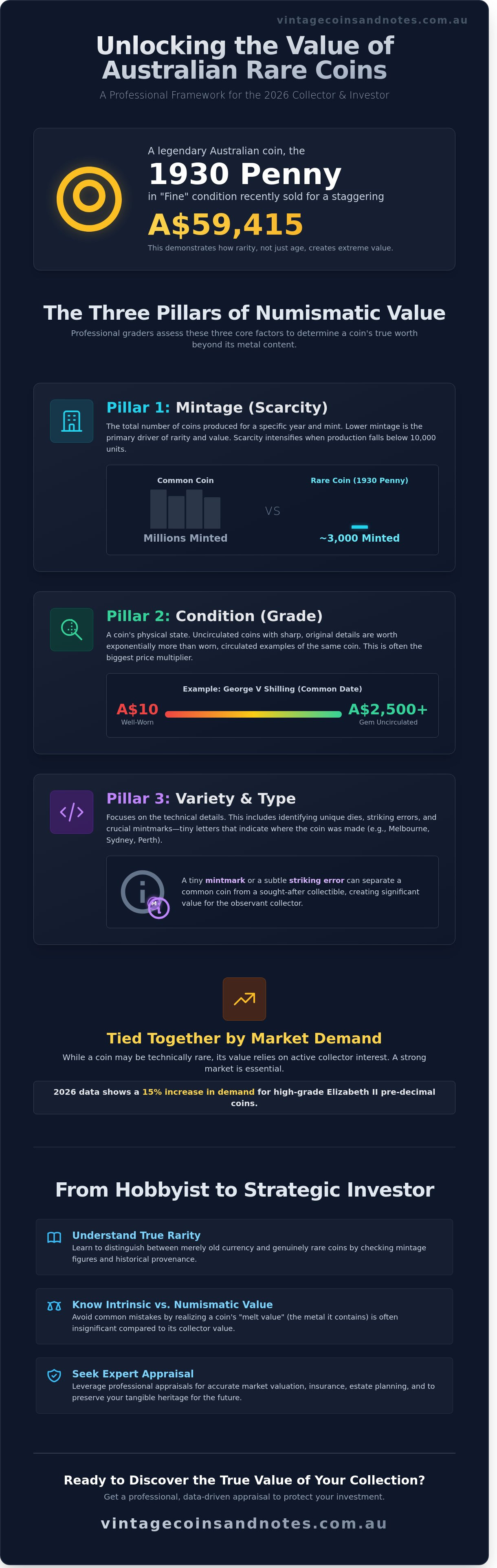
Did you know that a 1930 penny in "Fine" condition recently commanded a price of A$59,415 at a public auction? This represents a staggering return for a coin that was never officially meant to be issued for circulation. It's understandable if you feel a sense of hesitation when evaluating your own collection. The nuances of grading can be confusing, and the fear of being undervalued by a dealer is a legitimate concern for any hobbyist or investor. You want to ensure that your pieces of national heritage are treated with the respect and financial accuracy they deserve.
This guide provides the professional framework you need to identify and value australian rare coins with absolute certainty. We've compiled the essential data for the 2026 market to help you distinguish between common currency and investment-grade treasures. We'll explore the specific factors that define rarity; explain how to spot valuable mint errors; and provide a clear roadmap for obtaining an expert appraisal. By the end, you'll have the knowledge to preserve these historical artifacts for the next generation of collectors.
Key Takeaways
Learn to distinguish between common old currency and genuine australian rare coins by understanding the critical role of mintage figures and historical provenance.
Discover how the grading process creates a significant price gap between circulated and uncirculated specimens, ensuring you accurately assess your collection's potential.
Avoid common beginner mistakes by identifying the difference between a coin's intrinsic "melt value" and its true numismatic worth.
Master the essential steps for inspecting your finds, including the use of professional tools and reliable valuation guides to identify key mintmarks.
Transition from a casual hobbyist to a strategic investor by leveraging expert appraisals for insurance, estate planning, and long-term heritage preservation.
Understanding the Allure of Australian Rare Coins
Numismatics is the rigorous study and collection of currency and historical medals. For those exploring australian rare coins, it's vital to distinguish between items that are merely old and those that possess true rarity. A common penny from 1948 isn't necessarily valuable just because it's nearly eighty years old. In contrast, the 1930 Penny is legendary because only an estimated 3,000 were minted during the depths of the Great Depression. These pieces are more than hobbyist items; they serve as a robust hedge against economic volatility. During the 2008 financial crisis and the 2020 global market shifts, high-grade numismatic assets often held their value while traditional stocks plummeted. Holding a rare coin allows you to touch "history in your hands," creating a physical connection to the past that digital wealth cannot mirror. It's a way to secure capital in a form that has survived for centuries.
The Evolution of Australian Currency
Australia's monetary journey began with a chaotic mix of foreign silver and copper, later formalised by Governor King's 1800 Proclamation. The History of Australian Coins reached a significant milestone in 1910 with the launch of the first official Commonwealth silver coinage. This 1910 series, featuring King Edward VII, marked the start of a distinct national currency. The most dramatic shift occurred on February 14, 1966, when Australia transitioned to the decimal system. This changeover didn't just alter how people shopped; it sparked a massive surge in collector demand as the public rushed to save the retiring florins, shillings, and pennies from being melted down. This era remains the foundation of many modern collections, bridging the gap between the imperial past and the decimal present.
Tangible Heritage: Why We Collect
Each coin acts as a metallic snapshot of a specific political or social era. The 1923 Half Penny, with its low mintage of approximately 15,000, tells a story of post-war economic adjustments and industrial limitations. Rare coins play a crucial role in preserving national identity by documenting the symbols and leaders that shaped the country. In a 2026 financial world dominated by digital ledgers, physical assets remain highly relevant. Investing in australian rare coins provides a sense of permanence and security. Collectors and investors appreciate the lack of counterparty risk associated with a physical coin. It's a tangible legacy that maintains its integrity and historical significance regardless of technological changes or bank failures. A well-preserved specimen, backed by a clear provenance, represents a stable harbor for wealth in an increasingly intangible economy.
The Three Pillars of Numismatic Rarity
Determining the worth of australian rare coins involves more than just identifying their age. Professional collectors rely on three fundamental pillars: mintage, condition, and variety. Mintage figures represent the total number of coins produced in a specific year. When production numbers fall below 10,000 units, as seen with certain pre-decimal issues, scarcity drives the market price upward. You'll find that these historical production figures are carefully archived by the Royal Australian Mint, which serves as the definitive source for Australian currency specifications and historical output.
Condition acts as the second pillar. A coin that has circulated through thousands of hands loses its sharp details, which significantly lowers its appraisal value. The price gap is often staggering. For example, a common date George V shilling might sell for A$10 in a well-worn state, yet the same coin in "Gem Uncirculated" condition could command A$2,500 or more. Finally, type and variety focus on the technical execution of the coin. This includes identifying unique dies or historical anomalies that occurred during the striking process at the various mints across the country.
Market demand ties these pillars together. While a coin might be technically rare, its value relies on whether collectors are actively seeking that specific era. Current 2026 market data shows a 15% increase in demand for high-grade Elizabeth II pre-decimal coins as older collections reach the secondary market. If you're unsure where your collection sits within these categories, seeking an expert appraisal is the most reliable way to establish fair market value and ensure your assets are protected.
The Critical Role of Mintmarks
A mintmark is a tiny letter that indicates where a coin was struck. In Australia, the primary marks are 'S' for Sydney, 'M' for Melbourne, and 'P' for Perth. These minuscule details can change a coin's value by thousands of dollars. The 1923 Half Penny is a prime example; while other years are common, the 1923 Melbourne strike is a legendary rarity. Similarly, the 1930 Penny, though technically a product of accidental mintage, remains the king of australian rare coins because of its distinctive Melbourne Mint provenance and extremely low survival rate.
Professional Grading and PCGS Standards
Modern numismatics relies on the 70-point Sheldon Scale to define a coin's state of preservation. Third-party authentication from bodies like PCGS (Professional Coin Grading Service) provides a transparent, universal standard that protects both buyers and sellers. This process results in a 'Population Report,' which tracks exactly how many coins of a specific date have been graded at each level. If a coin is the single highest-graded example in existence, its value transcends standard price guides, often setting new records at auction due to its proven scarcity and confirmed authenticity.
Common Misconceptions: Why Age Doesn’t Always Equal Value
The most frequent error for new collectors involves equating antiquity with scarcity. A George VI penny from 1948 might feel like a relic, yet the Melbourne and Perth mints produced over 25.8 million of them. Unless that specific coin remains in its original, "as-struck" brilliance, its market value rarely exceeds A$2. This reality distinguishes common currency from genuine australian rare coins. Scarcity is driven by low mintage numbers and survival rates in high grades, not the mere passage of decades.
Distinguishing between melt value and numismatic value is a vital skill. Australian silver coinage underwent a significant change in 1946. Coins minted between 1910 and 1945 contain 92.5% sterling silver, while those from 1946 to 1963 contain only 50% silver. A heavily circulated 1947 florin is essentially a silver bullion asset. Its value fluctuates with the daily spot price of silver, currently around A$45 per ounce in early 2025. It lacks the historical premium found in investment-grade specimens.
Found coins usually differ from investment-grade pieces. A 1930 penny discovered in a jar of loose change will almost certainly be in "Good" or "Very Good" condition, showing heavy wear on the king's crown. While still valuable due to its 3,000-unit mintage, it won't command the A$50,000+ prices seen at auction for "About Uncirculated" examples. Condition is the primary driver of price growth. Professional collectors prioritize "eye appeal" and the absence of surface marks over the date alone.
The Cleaning Myth: A Costly Mistake
New enthusiasts often attempt to "improve" a find by scrubbing it with polish or bicarb soda. Don't do this. Cleaning a coin is the fastest way to destroy its market value. A coin's "patina" or "bloom" is a thin layer of oxidation that develops over 80 years. It proves the coin's authenticity and original state. Scrubbing creates microscopic hairlines that professional grading services, such as PCGS, identify immediately. A cleaned coin often receives a "Details" grade, which can reduce its resale price by 60% to 90% compared to an untouched specimen.
Decimal Rarities: Modern Treasures
Age is secondary to demand and mintage in the decimal era. Several coins currently in circulation are harder to find than pennies from the 1950s. For example, the 2012 Red Poppy A$2 coin had a mintage of only 503,000. By 2024, its market value climbed toward A$150 in circulated condition. Understanding these nuances is essential for anyone building a portfolio of australian rare coins. Keep a sharp eye out for these specific errors:
The 2000 A$1/10c Mule: A rare hybrid where a 10-cent head die was paired with a dollar tail die, creating a distinct double rim.
The 2007 "Double Header" 5c: An error coin featuring the Queen's portrait on both sides.
Low Mintage A$2: The 2011 Aboriginal Elder and 2012 Gold Poppy remain highly sought after by collectors for their limited release numbers.
How to Identify and Protect Your Rare Coin Finds
Identifying a potential treasure requires more than a keen eye; it demands a systematic approach. Your first task is a detailed physical inspection using a 10x magnification loupe to check for mintmarks, such as the small 'H' on 1915 florins. Tiny details often dictate the difference between a common circulation piece and a high-value specimen. Once you've identified the year and variety, consult a reliable rare australian coins value guide to establish a baseline price.
Don't touch the face of the coin. Natural oils on your fingertips cause permanent staining and "fingerprint toning" that reduces the grade. Always grip the coin by its edges. If the item appears to be an investment-grade piece, seek a professional appraisal. Items valued over A$250 deserve a formal assessment to confirm authenticity and state of preservation.
Essential Tools for the Budding Numismatist
A standard magnifying glass isn't enough for serious work. Invest in a 10x or 20x triplet loupe to reveal surface hairlines and mintmark nuances. Digital scales accurate to 0.01 grams are equally vital. For instance, a genuine 1923 halfpenny should weigh approximately 5.67 grams; any significant deviation suggests a counterfeit. Finally, keep a recent edition of the Renniks Australian Coin & Banknote Values catalogue on your shelf. It remains the definitive reference for mintage figures and historical varieties.
Storage and Preservation Best Practices
Improper storage is the primary cause of value loss in australian rare coins. Avoid cheap "sticky" albums that contain PVC (polyvinyl chloride). Over time, PVC breaks down and releases acidic gases, creating a sticky "green slime" that eats into the metal surface. This damage is often irreversible. Instead, use archival-quality Mylar flips or acid-free cardboard 2x2 holders. These materials are chemically inert and provide a safe barrier against the elements.
Environment matters as much as the container. Store your collection in a cool, dry place where the temperature stays near 20 degrees Celsius. High humidity is a catalyst for corrosion, especially for copper and bronze pennies. Aim for a relative humidity level below 50 percent to ensure your coins remain in the same condition for the next generation of collectors. If you've discovered an item of interest, our team provides expert coin appraisals to help you understand its true heritage.
Building a Legacy: Professional Numismatic Services
Transitioning from a casual hobbyist to a strategic numismatic investor requires a shift in perspective. It’s about moving beyond the aesthetic appeal of a single piece to understanding how a portfolio of australian rare coins functions as a tangible asset class. This progression relies on accurate data, historical context, and a commitment to quality over quantity. A well-curated collection serves as a hedge against inflation and a bridge between generations, preserving wealth through items of historical significance.
Professional Valuation and Appraisal
Formal written valuations are essential for insurance, probate, and estate planning. During a professional appraisal, we distinguish between Retail Replacement Value and Fair Market Value. The former represents the cost to acquire an identical item from a dealer immediately, which is crucial for insurance policies. The latter reflects the price a willing buyer and seller would agree upon in an open market, often used for estate settlements or private sales. Our team utilizes 45 years of industry experience to provide these assessments, ensuring every specimen is evaluated against current auction realizations and private treaty sales. This precision provides the peace of mind that your family’s heritage is documented and protected.
Investing for the Long Term
Diversifying a wealth strategy involves looking toward assets with proven resilience. Australian gold sovereigns and coins graded by the Professional Coin Grading Service (PCGS) offer high liquidity and transparency in the global market. For those utilizing a Self-Managed Super Fund (SMSF), strict Australian Taxation Office (ATO) regulations apply. These rules include:
Mandatory independent valuations every three years to ensure compliance.
Specific storage requirements where items cannot be kept in a personal residence.
Strict prohibitions against the personal use or display of the assets.
A trusted dealer relationship is the foundation of a successful collection. We assist in sourcing authentic items with documented provenance, ensuring that your capital is placed in investment-grade material. Holding history in your hands is a privilege, but it’s also a financial responsibility that requires expert guidance. Whether you’re managing an estate or seeking to expand your holdings of australian rare coins, the right expertise makes the difference. We invite you to reach out for a no-obligation valuation to determine the current standing and potential of your numismatic assets.
Securing Your Place in Australian Numismatic History
Success in the 2026 market requires moving beyond the myth that age equals value. True collectors focus on the three pillars of rarity: mintage figures, survival rates, and the technical precision of condition. When you identify australian rare coins within your portfolio, maintaining their physical integrity through professional PCGS grading is the most effective way to preserve their fair market value. It's a process that turns a simple hobby into a lasting financial legacy.
Vintage Coins & Notes provides the steady guidance needed to navigate these complexities. With over 45 years of numismatic expertise, our family-owned team specializes in the authentication and valuation of high-grade Australian rarities. We prioritize integrity and professional decorum, ensuring every collector receives a transparent assessment of their items' provenance. Whether you're managing a private collection or an estate liquidation, we're here to help you hold history in your hands with confidence.
Ready to establish the true worth of your finds? Request an Expert Appraisal from Vintage Coins & Notes for a professional, no-obligation valuation. We look forward to helping you document and protect your piece of Australia's rich heritage.
Frequently Asked Questions
What is the most valuable rare Australian coin?
The 1930 Proof Penny holds the record as the most valuable Australian rare coin, with a specimen selling for A$1.15 million in 2019. While the circulating version is famous, only six proof versions are known to exist. Other high-value items include the 1813 Holey Dollar, with top-tier examples frequently exceeding A$500,000 at auction. These prices reflect extreme rarity and the historical significance of holding history in your hands.
How can I tell if my old Australian coins are worth money?
You can determine value by identifying the specific year, mint mark, and physical condition of the piece. Look for key dates like the 1923 Half Penny or the 1933 Shilling, as low mintage figures drive collector demand. Wear and tear impact the price heavily; a coin in "Uncirculated" condition can be worth 10 times more than one in "Fine" condition. We recommend an expert appraisal to establish the fair market value.
Is it worth getting my coins PCGS graded?
Professional PCGS grading is highly recommended for any australian rare coins with a potential value exceeding A$200. This process provides an independent guarantee of authenticity and a numeric grade, which often increases the resale price by 20% to 30%. Because collectors pay a premium for "slabbed" coins, the investment in grading fees ensures your asset meets international standards. It removes the subjectivity of condition, providing peace of mind for both parties.
Where can I find a reliable Australian penny value list?
The most reliable resource is the Renniks Australian Coin and Banknote Values guide, currently in its 31st edition. It provides comprehensive mintage data and price estimates across various grades. For real-time data, professional numismatic auction results from the last 12 months offer the most accurate reflection of what buyers actually pay. You should treat online marketplace listings with caution, as asking prices often diverge from actual realized sales.
Can I include rare coins in my SMSF?
You can include investment-grade coins in a Self-Managed Super Fund provided you follow Australian Taxation Office regulations. These rules require that the assets are insured within seven days of purchase and stored in a secure, non-residential location. You can't display the coins in your home or "use" them for personal enjoyment. An annual independent valuation is mandatory to ensure the fund's financial statements accurately reflect the current portfolio worth.
What should I do with a deceased estate coin collection?
The first step is to secure the collection and seek a professional appraisal to avoid underselling valuable heritage items. Don't clean the coins, as removing the natural patina can reduce the value by up to 90%. We offer a no-obligation valuation service to help families understand the historical and financial significance of an estate. This methodical approach ensures that rare dates aren't overlooked during the liquidation process.
Why is the 1930 Penny so famous?
The 1930 Penny is famous because it was never officially intended for circulation, yet roughly 3,000 pieces entered the economy. This accidental mintage created a "holy grail" for local collectors during the Great Depression. Its scarcity is well-documented, and owning an authentic specimen is considered a pinnacle of australian rare coins collecting. The story of its survival against the odds adds a layer of romanticism to its significant financial value.
Does the Royal Australian Mint still produce rare coins?
The Royal Australian Mint continues to produce rare items through limited mintage Non-Circulating Legal Tender and special release sets. For example, the 2012 Red Poppy $2 coin had a mintage of only 503,000, causing its value to rise above A$300 in recent years. While these modern releases are popular, they differ from historical rarities because their scarcity is manufactured by design rather than by historical accident or low survival rates.
A single 7.98-gram disc of 22-carat gold struck at the Melbourne Mint in 1901 carries more weight in a modern portfolio than almost any digital asset. While many investors focus solely on fluctuating spot prices, the end…
Holding a 1930 Australian Penny isn't just about owning a piece of copper. It's about possessing a tangible relic of the Great Depression that, in high grades, has seen its value climb toward A$30,000 at recent auctions.…
A raw coin is merely a historical artifact; a PCGS slabbed specimen is a globally recognized financial instrument. For the serious Australian investor, pcgs graded coins represent the gold standard in risk mitigation, re…