Rare Australian Coins: The Investor’s Guide to Numismatic Heritage (2026 Edition)
March 09, 2026
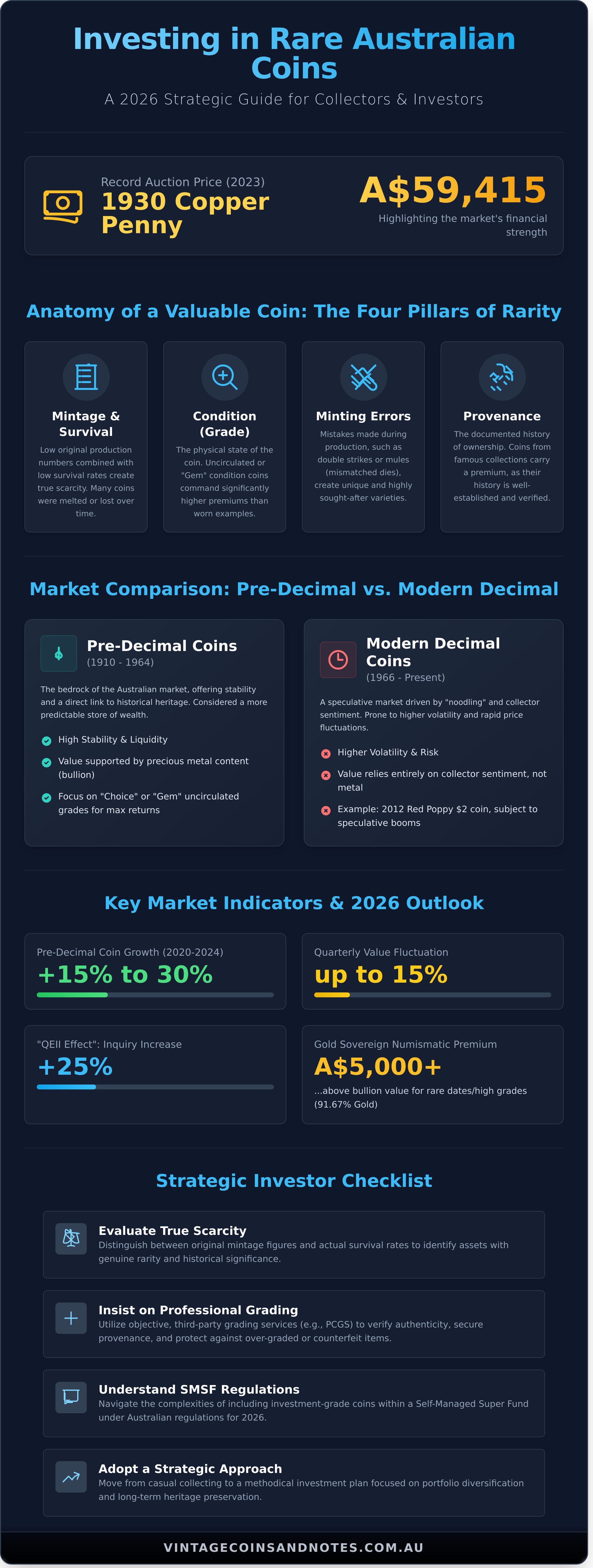
A single 1930 copper penny achieved a record auction price of A$59,415 in late 2023, a figure that highlights the enduring financial strength of the numismatic market. You've likely noticed that the transition following the passing of Queen Elizabeth II has introduced a new layer of complexity to the trade of rare australian coins. It's a period of both opportunity and uncertainty. The difference between a specimen's book value and its fair market value can fluctuate by as much as 15% in a single quarter. You want to ensure that your acquisitions are authentic and that your capital is protected from the risks of over-graded inventory or sophisticated counterfeits.
This 2026 edition of our guide provides the clarity you need to distinguish between historical curiosity and genuine investment-grade assets. We'll show you how to identify high-growth potential coins from the pre-decimal era and modern decimal rarities while mastering the technical specifications of professional grading. By the end of this article, you'll understand how to integrate these tangible pieces of heritage into a balanced retirement portfolio with confidence. We'll move from the historical context of early sovereigns to the practicalities of secure, long-term preservation and expert appraisal.
Key Takeaways
Learn to distinguish between original mintage figures and actual survival rates to identify assets with genuine scarcity and historical significance.
Compare the enduring value of pre-decimal blue-chips like the 1930 Penny against the rising market performance of modern rare australian coins.
Understand the necessity of objective third-party grading to secure the provenance and financial integrity of your high-value numismatic holdings.
Navigate the complexities of including investment-grade coins within a Self-Managed Super Fund (SMSF) under the specific Australian regulations for 2026.
Establish a methodical approach to portfolio management, moving from casual collecting to a strategic investment plan focused on long-term heritage preservation.
The Allure of Rare Australian Coins: History, Scarcity, and Value
Defining rarity within the Australian numismatic landscape requires a nuanced understanding of both mintage figures and survival rates. A common misconception among new collectors is that a low mintage automatically equates to high value. In reality, the market prioritizes the number of surviving specimens in superior grades. For example, the 1930 Penny is legendary not just because of its estimated mintage of 3,000, but because so few were preserved in anything beyond a well-worn state. These rare australian coins serve as a bridge between our economic past and modern investment portfolios. Since the 2008 global financial crisis, we've seen a consistent shift where collectors view these items as high-performance alternative assets rather than mere hobbies.
The historical significance of these pieces cannot be overstated. By studying the History of Australian Currency, we see how the 1910 transition from British sterling to a distinct Australian coinage created a legacy of tangible heritage. This heritage sustains long-term demand because it offers a sense of permanence that digital assets cannot replicate. When you possess a 1923 Halfpenny or a 1915-H Florin, you're literally holding history in your hands. Between 2020 and 2024, the auction records for "finest known" examples of pre-decimal coins have climbed steadily, with some prices increasing by 15% to 30% as investors seek refuge in physical wealth.
The 2022 passing of Queen Elizabeth II has fundamentally redefined the 2026 market outlook. This event marked the end of a 70-year era, making her coinage a finite resource. As the Royal Australian Mint transitions fully to the effigy of King Charles III, collectors are reassessing the late-era Elizabeth II issues. We've observed a 25% increase in inquiries regarding the final "Jody Clark" portrait coins, as the market prepares for a future where these pieces are no longer in circulation. This shift reinforces the brand of the "Fair Dealer," where we prioritize the accuracy of a grade to ensure long-term credibility for our clients.
Pre-Decimal vs. Decimal: Two Distinct Markets
Pre-decimal coins, minted between 1910 and 1964, remain the bedrock of the Australian market. These issues offer a level of liquidity and stability that decimal coins often lack. While the rise of "noodling" has created a speculative boom in decimal $2 coins, such as the 2012 Red Poppy, these markets are prone to higher volatility. A pre-decimal silver florin maintains a baseline value tied to its bullion content, whereas a commemorative $2 coin relies entirely on collector sentiment. For serious investors, the pre-decimal era provides a more predictable trajectory for wealth preservation. We suggest focusing on "Choice" or "Gem" uncirculated grades to maximize potential returns.
The 2026 Market Outlook
Looking toward 2026, the demand for Australian gold sovereigns and half-sovereigns remains robust. Sovereigns struck at the Sydney, Melbourne, and Perth Mints are particularly prized for their 91.67% gold purity and historical provenance. It's essential for every collector to recognize that numismatic value is the premium paid over the metal content. While a standard sovereign tracks the spot price of gold, a rare date or a high-grade specimen can command a premium of A$5,000 or more above the bullion value. As the market evolves, we continue to offer a no-obligation valuation to help families understand the fair market value of their collections during estate liquidations or portfolio reviews.
Anatomy of a Rarity: What Makes an Australian Coin Valuable?
Identifying rare australian coins requires looking beyond the face value of the metal. It's a process of holding history in your hands and recognizing the subtle markers that separate a common circulation piece from a museum-quality specimen. Four primary pillars dictate the market price: mintage, condition, error, and provenance. While mintage refers to the total number of coins produced by the mint in a specific year, it doesn't always tell the full story. Distribution scarcity occurs when a high number of coins were minted, yet few entered circulation or survived the melting pot of subsequent decades.
The 1923 Half Penny serves as a perfect illustration. Its recorded mintage is approximately 1,113,000, yet it remains one of the most sought-after pre-decimal rarities because only a tiny fraction of that number was actually issued to the public. Collectors often consult records from the Numismatic Association of Victoria to understand these historical discrepancies. Beyond raw numbers, the "strike" of a coin determines its visual depth. A coin's strike refers to the sharpness of the design achieved during the minting process. If the dies were worn or the pressure was insufficient, the resulting coin lacks detail. A well-struck coin with "full pearls" on the crown of King George V will always command a higher premium than a weakly struck example, even if both show similar levels of wear.
Psychology also plays a massive role in valuation. Certain designs capture the public imagination more than others. The 1930 Penny is the "King" of Australian numismatics not just because of its rarity, with roughly 3,000 pieces in existence, but because it wasn't officially recorded in mint reports. This accidental release created a legendary status that has persisted for nearly a century, making it the centerpiece of many serious portfolios.
The Role of Minting Errors and Anomalies
Errors create unique pieces that deviate from the standard production run. These anomalies represent some of the most fascinating rare australian coins available to modern collectors. "Mules" are particularly prized; these occur when two dies intended for different coins are paired together. The 2000 $1/10c mule is a famous modern example. A mint technician mistakenly used a 10-cent obverse die with a standard $1 reverse, resulting in a $1 coin with a distinctive double rim on the "heads" side. Other valuable errors include die cracks, which appear as raised lines, and off-centre strikes where the planchet wasn't properly aligned during the blow.
Condition and the Sheldon Scale
Numismatists use the 70-point Sheldon Scale to define a coin's state of preservation. The value difference between an "Extremely Fine" (EF) coin and an "Uncirculated" (UNC) example is often staggering. A 1910 Florin might be valued at A$450 in EF condition, but a Gem Uncirculated specimen can exceed A$15,000 at auction. Beyond technical points, "eye appeal" and original mint lustre are vital. Lustre is the satiny sheen found on coins that haven't been cleaned or heavily handled. If you're uncertain about the grade of your collection, seeking expert appraisals is the most reliable way to determine its true market standing.
Iconic Rarities: A Comparative Analysis of Australia’s Most Wanted
The Australian numismatic market in 2026 reflects a fascinating divide between established pre-decimal blue chips and the surging popularity of modern decimal icons. While pre-decimal assets offer long-term stability and historical depth, modern rare australian coins often provide faster capital growth for those who can identify emerging trends early. Holding history in your hands requires an understanding of why certain dates command five-figure sums while others remain mere curiosities. The transition from the rigid stability of the pound to the vibrant diversity of the dollar has created two distinct classes of investment-grade material.
The 1930 Penny remains the undisputed King of Australian coins. Its status stems from an accidental mintage during the Great Depression. No pennies were ordered for circulation that year; however, an estimated 3,000 pieces were struck. This scarcity has seen prices for "Fine" examples consistently exceed A$25,000 in recent auction results. For the ultimate in Australian gold, the 1852 Adelaide Pound represents the nation's first gold coin. Struck to alleviate a currency shortage during the Victorian gold rush, the Type 2 variety is a cornerstone of any serious portfolio. You can view primary examples of these historic strikes in the National Coin Collection, which documents the evolution of our currency from these early colonial experiments.
Contrast these historical giants with the 2012 Red Poppy $2 coin. With a mintage of just 503,000, this was Australia's first circulating $2 coin with color. It has seen a 4,000% increase in value over its face denomination in just over a decade. It signals a shift where modern commemoratives now compete with colonial rarities for collector attention, driven by a new generation of enthusiasts who value visual impact alongside mintage figures.
The Pre-Decimal Heavyweights
The 1923 Half-Penny is a deceptive rarity. Its estimated mintage of roughly 15,000 makes it significantly scarcer than many full pennies. It's an essential acquisition for those completing a date set. Meanwhile, the 1927 Canberra Florin remains a masterpiece of design. It was issued to mark the opening of the first Parliament House. While not as rare as the 1930 Penny, its historical heritage makes it a popular entry point for investment-grade collecting. Gold Sovereigns from the Sydney, Melbourne, and Perth Mints also provide a secure hedge. The Sydney Mint issues struck between 1855 and 1870 are particularly prized for their unique "Australia" reverse design and local provenance.
Decimal Rarities and Error Coins
Precision is vital when hunting for decimal rare australian coins. The 1966 Wavy Baseline 20-cent coin is a prime example. Collectors look for a subtle upward curve on the top of the horizontal bar of the '2' in '20'. This variety can fetch over A$400 in high grades. For silver investors, the 1966 Round 50-cent coin is a staple. It contains 80% silver, which equates to approximately 0.34 ounces of fine metal. It was replaced by the dodecagonal shape in 1969 to avoid confusion with the 20-cent piece and because the rising price of silver exceeded the coin's face value. Finally, low mintage $2 coins like the 2011 "Marsupial" or various Remembrance Day issues continue to dominate the secondary market. Tracking these mintages through official reports ensures you're paying fair market value based on actual scarcity.
Professional Grading and Preservation: Securing Your Investment
The transition from subjective dealer assessments to international third-party standards changed the Australian numismatic market forever. Before the mid-1980s, a coin's condition was often a matter of debate between buyer and seller, leading to inconsistent pricing. This changed in 1986 with the establishment of the Professional Coin Grading Service (PCGS). They introduced a standardized 70-point Sheldon scale that removed personal bias from the transaction. For anyone holding rare australian coins, this objectivity provides a price floor based on historical auction data rather than a local shop's opinion. It's the difference between a "nice" coin and a verified financial asset.
Never clean a coin. A single wipe with a soft cloth can leave microscopic hairlines that reduce a coin’s value by 90% instantly. Collectors prize "original mint luster," which is the delicate flow of metal created during the striking process. Once removed, it's gone forever. Professional numismatists spot "dipped" or chemically altered surfaces under 10x magnification immediately. These coins are often returned from grading services with a "Details" grade, which severely limits their liquidity. A 1930 Penny with original chocolate-brown surfaces will always outvalue a cleaned specimen, regardless of how "shiny" the latter appears.
The PCGS Advantage in Australia
Slabbing a coin involves sealing it in a tamper-evident, sonically welded polymer holder. This protects the metal from the humid Australian climate, which is particularly volatile in coastal regions. The PCGS Population Report is a vital tool for investors because it tracks exactly how many specimens of a specific date and grade exist. If you own one of only five 1923 Halfpennies graded at MS64, you possess documented proof of rarity. Graded coins consistently achieve 20% to 55% higher premiums at major auction houses like Noble Numismatics compared to raw, uncertified examples.
Conservation vs. Restoration
Professional conservation is different from cleaning. It involves removing harmful contaminants like PVC residue without altering the coin's original surface. In 2015, PCGS launched its Restoration service to help collectors stabilize coins suffering from environmental damage. Don't attempt this at home. Even the oils from your skin can cause permanent "fingerprint toning" on a proof 1937 Crown. Always handle raw coins by their edges using lint-free cotton gloves or specialized tongs to maintain the integrity of the strike.
Storage choices dictate the future value of your collection. Avoid cheap plastic albums manufactured before 2005 that contain PVC. Over time, these chemicals break down and create a green, acidic residue that eats into the silver or copper. Use non-reactive Mylar flips or archival-quality cabinets. Humidity in cities like Brisbane or Sydney can cause uneven, ugly toning. Placing silica gel packets in a safe can maintain a stable environment, protecting your rare australian coins from oxidation and ensuring they remain in the same condition for the next generation of collectors.
If you're uncertain about the condition or authenticity of your collection, our experts provide a professional coin appraisal to help you determine the best path for grading and preservation.
Building and Liquidating a Rare Coin Portfolio with Vintage Coins & Notes
Transitioning from a casual hobbyist to a serious investor requires a shift in perspective. While a collector might buy based on personal affinity, an investor acquires assets based on scarcity, condition, and historical price data. Developing a strategic acquisition plan involves identifying rare australian coins that possess a proven track record of capital growth. For example, the 1930 Penny has maintained its status as a cornerstone of the market for over 90 years. A disciplined investor focuses on "key dates" and high-grade specimens, as these items often show the greatest resilience during economic fluctuations. We recommend a diversified approach, balancing iconic copper rarities with high-purity gold sovereigns to create a robust portfolio.
Liquidity is the final stage of the investment cycle. Achieving fair market value depends heavily on the method of sale. The consignment process allows your items to be presented to a targeted audience of serious buyers, often resulting in higher returns than a quick "cash-and-carry" transaction. We handle the technical aspects, including professional grading and historical research, to ensure your coins are positioned correctly. This methodical approach ensures that the premium you paid for quality is recovered, and ideally exceeded, when it's time to exit the market.
Expert Advice and SMSF Consultation
Holding numismatic assets within a Self-Managed Super Fund (SMSF) is a sophisticated strategy that requires strict compliance with Australian Taxation Office (ATO) standards. Under the 2026 regulations, the requirements for storage and insurance are more stringent than ever. Assets must not be stored in a private residence or displayed; they require secure, independent vaulting and specific insurance policies that name the fund as the beneficiary. We assist trustees in selecting investment-grade items that meet the "sole purpose test" while focusing on long-term appreciation. Our 45-year track record in the Australian market provides the stability and historical data necessary to justify these acquisitions to fund auditors.
Regulatory Compliance: We ensure all SMSF purchases include the required paperwork for annual audits.
Asset Selection: We prioritise coins with a mintage of under 1,500 or those with exceptional "eye appeal" that drives auction competition.
Secure Custody: We provide guidance on third-party storage solutions that satisfy the 2026 ATO mandates.
Professional Valuation Services
Accurate pricing is the foundation of any successful transaction. It's vital to distinguish between a "retail price," which includes dealer overheads, and an "auction estimate," which reflects the current bidding climate. For those managing deceased estates, the stakes are particularly high. We've seen many instances where families inadvertently sell rare australian coins for their silver melt value, missing out on thousands of dollars in numismatic premiums. A professional appraisal identifies these hidden gems, such as the 1922/21 Overdate Threepence or the 1946 Shilling, ensuring the estate's value is fully realised.
Our valuation process is transparent and grounded in real-time market data. Whether you require a formal document for insurance coverage or a verbal assessment for a potential sale, we provide a sober, factual analysis of your collection's worth. Contact David Jobson for a no-obligation valuation of your collection to discover the true market standing of your holdings. We offer a safe harbour for those seeking clarity in a complex market, treating every item with the reverence its history deserves.
Securing Your Numismatic Legacy for 2026 and Beyond
Building a robust portfolio of rare australian coins requires more than just an appreciation for history; it demands a disciplined approach to provenance and technical preservation. As the 2026 market demonstrates, the premium on PCGS-graded specimens continues to rise, providing a transparent benchmark for SMSF portfolios and private collectors. Whether you're tracking the price movements of a 1930 Penny or managing a complex deceased estate, professional grading remains the most critical factor in determining long-term capital growth. At Vintage Coins & Notes, we bring over 45 years of professional numismatic experience to every transaction. We're specialists in PCGS-certified rarities and provide expert valuations for insurance and estate purposes. This ensures your physical assets are accurately appraised and protected against market volatility. Holding a piece of Australia’s tangible heritage is a rewarding journey that balances financial strategy with a deep respect for our national story. It's time to partner with a dealer who values integrity and historical accuracy. We're ready to help you navigate the nuances of the current market with confidence.
How do I know if my Australian coin is rare and worth money?
You can determine a coin's rarity by checking its specific mintage figures and its current physical grade. A 1923 Halfpenny is rare because the Melbourne Mint only produced 15,000 units. Use a 10x magnifying glass to look for original mint lustre or wear on the highest points of the design. Compare your findings to recent 2024 auction results to establish a realistic market value based on actual sales.
What is the most valuable Australian coin ever found in circulation?
The 1930 Penny is the most valuable coin ever discovered in general circulation, with a standard "Fine" grade example valued at A$25,000 in today's market. While records suggest 3,000 were minted, only about 1,500 are accounted for by collectors. Another significant find is the 2000 $1/10c "mule" error coin. These hybrid coins can fetch upwards of A$4,000 depending on their state of preservation.
Is it worth getting my coins PCGS graded in Australia?
Professional grading through the Professional Coin Grading Service (PCGS) is essential for high-value rare australian coins to guarantee their authenticity and numeric grade. A certified grade can increase a coin's resale price by 40% because it removes the buyer's risk. This third-party verification provides a clear, objective standard that's recognised by auction houses and investors worldwide, ensuring you receive a fair price when you decide to sell.
Why is the 1930 Penny so famous and what is it worth in 2026?
The 1930 Penny is famous because it was never officially intended for circulation, yet a small batch reached the public during the Great Depression. By 2026, market analysts project a mid-range specimen could reach a value of A$35,000, following a consistent 5% annual growth trend. Its status as a "accidental" issue makes it the most iconic piece of Australian numismatic history for any serious private collection.
Can I include rare coins and banknotes in my Self-Managed Super Fund (SMSF)?
You can include numismatic assets in an SMSF, provided you follow the Australian Taxation Office (ATO) regulations updated in July 2011. These rules require that your coins are insured within seven days of purchase and stored in a secure, non-residential location. You can't display them in your home or business. This ensures the investment meets the "sole purpose test" for providing retirement benefits to fund members.
How should I clean my old coins to make them look better?
You should never clean your coins, as doing so can strip away the original surface and reduce the collector value by up to 90%. Abrasive cloths and chemical dips leave microscopic scratches that professional graders identify instantly. If your coins have active corrosion or PVC residue from old 1980s plastic flips, it's better to consult a professional conservation expert who uses museum-grade techniques to stabilise the metal without damage.
What is the difference between a proof coin and an uncirculated coin?
A proof coin is a specially struck piece made for collectors using polished dies and blanks, resulting in a mirror-like background and frosted details. Uncirculated coins are standard business strikes produced for general use that simply never entered the cash economy. Proof mintages are much lower; for example, the 1934 Melbourne Centenary Florin had a proof mintage of just 75, making it far rarer than its standard counterpart.
Where can I get an expert valuation for a deceased estate coin collection?
You should seek a formal appraisal from a dealer who is a member of the Australasian Numismatic Dealers Association (ANDA) to ensure an accurate assessment of rare australian coins. We offer a professional, no-obligation valuation service that examines the provenance and condition of every sovereign, crown, and florin in the estate. This methodical approach provides executors with a clear document of value, reflecting the current fair market prices in Australia.
A single 7.98-gram disc of 22-carat gold struck at the Melbourne Mint in 1901 carries more weight in a modern portfolio than almost any digital asset. While many investors focus solely on fluctuating spot prices, the end…
Holding a 1930 Australian Penny isn't just about owning a piece of copper. It's about possessing a tangible relic of the Great Depression that, in high grades, has seen its value climb toward A$30,000 at recent auctions.…
A raw coin is merely a historical artifact; a PCGS slabbed specimen is a globally recognized financial instrument. For the serious Australian investor, pcgs graded coins represent the gold standard in risk mitigation, re…