1966 Australian Fifty Cent Coin: The Complete Collector’s & Investor’s Guide
March 10, 2026
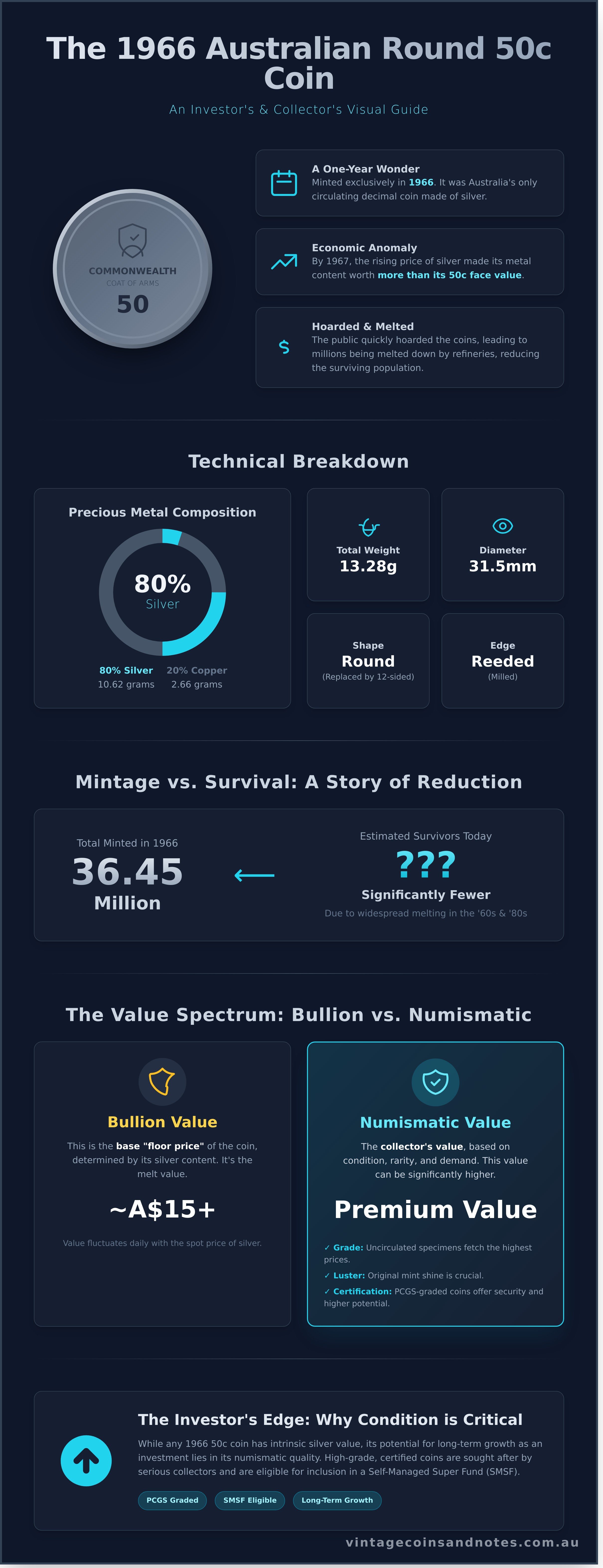
In 1966, the Royal Australian Mint struck 36.45 million round fifty cent coins, but by 1968, the rising price of silver meant the metal content was worth more than the coin's face value. This economic quirk turned the 1966 australian fifty cent coin into a vanished relic of decimalisation, as the public began hoarding them almost immediately. It's understandable if you're unsure whether your coins are worth their A$15 melt value or a much higher numismatic premium. You might worry about overpaying for "cleaned" pieces or struggle to tell a genuine specimen from a modern fake. This guide provides the professional authority you need to navigate these uncertainties. You'll discover the historical reasons behind its one year mintage, learn how to identify high-grade strikes that attract serious investors, and understand why preserving the original finish is vital for value. We'll break down current market prices, technical specifications, and the grading secrets that define this unique piece of Australian heritage.
Key Takeaways
Understand the historical significance of the 1966 australian fifty cent coin, the only silver decimal piece ever issued for general circulation in Australia.
Learn to calculate the intrinsic bullion value based on the coin's 80% silver composition, establishing a reliable "floor price" for your holdings.
Identify the specific numismatic characteristics, such as mint luster and strike quality, that elevate a specimen from its silver weight value to a high-premium collectable.
Discover strategic investment approaches, including the benefits of holding PCGS-graded coins within a Self-Managed Super Fund (SMSF) for long-term growth.
The History of the 1966 Australian Fifty Cent Coin: A Historical Accident
On 14 February 1966, Australia underwent a seismic shift in its national identity by replacing the British-style pounds, shillings, and pence with a modern decimal system. This transition, famously known as "C-Day," was a massive logistical undertaking involving the conversion of bank accounts and cash registers across the nation. The 1966 australian fifty cent coin arrived as the flagship of this new currency line-up. It was a heavy, impressive piece of silver that felt substantial in the palm. Unlike the smaller bronze and cupro-nickel denominations, this coin carried the prestige of 80% silver and 20% copper. The Royal Australian Mint produced it with a diameter of 31.5 millimetres and a weight of 13.28 grams. It remains the only decimal coin ever issued for general circulation in Australia to contain such a high percentage of precious metal.
The decision to use silver was rooted in tradition, yet it quickly proved to be a fiscal miscalculation. As the global demand for industrial silver accelerated throughout 1966, the market price of the metal climbed. Each Australian round fifty-cent coin contains approximately 10.62 grams of fine silver. By the time 1967 arrived, the value of the raw silver inside the coin was worth more than the 50 cents stamped on its face. This economic anomaly meant that the government was effectively losing money for every coin they struck and distributed. The design featured the Commonwealth Coat of Arms on the reverse, designed by Stuart Devlin. This intricate engraving of the kangaroo and emu against a backdrop of flowering wattle added to the aesthetic appeal, making it a favourite for those holding history in their hands.
Why was it only minted for one year?
The Reserve Bank of Australia noticed a troubling trend almost immediately after the release. The coins were vanishing from circulation. Instead of being used to buy bread or milk, the public was hoarding them in jars and safe deposit boxes because they recognised the intrinsic value of the silver. By the end of 1966, the Mint ceased production of the round design. The logistical challenge of a disappearing denomination forced a three-year hiatus. It wasn't until 1969 that the 12-sided cupro-nickel version arrived to solve the hoarding problem.
The Mintage Mystery: How many are actually left?
Official records from the Royal Australian Mint state a total mintage of 36.45 million coins. However, this figure is deceptive when assessing modern rarity. During the late 1960s and again during the silver boom of 1980, the government and private refineries melted down millions of these coins to reclaim the bullion. This mass destruction significantly reduced the surviving population in the secondary market. While "circulated" pieces are still found in estate collections, high-grade, investment-grade examples are much harder to secure. Every survivor represents a narrow escape from the furnace.
Mintage Year: 1966 only
Silver Content: 80% Silver (0.3416 oz ASW)
Shape: Round (replaced by dodecagonal in 1969)
Weight: 13.28 grams
Technical Specifications and Design: Holding History in Your Hands
The 1966 australian fifty cent coin isn't just currency; it's a physical artifact of Australia's transition to decimalisation on 14 February 1966. This coin possesses a heft that modern dodecagonal versions lack, making it immediately recognisable by touch alone. Its circular shape was short-lived. The rising cost of silver and public confusion with the twenty-cent piece led to a permanent design change by 1969. For many Australians, these coins were tucked away in jars and drawers as soon as the government announced they'd be replaced. This hoarding instinct preserved many specimens, yet finding one in "choice uncirculated" condition remains a pursuit for the dedicated collector.
Physical Property Breakdown:
Total Weight: 13.28 grams
Diameter: 31.5 millimetres
Edge Profile: Milled/Reeded
Composition: 80% Silver, 20% Copper
Net Silver Content: 10.62 grams (0.3416 troy ounces)
The Machin and Devlin Design
The obverse features the "First Portrait" of Queen Elizabeth II by Arnold Machin. This depiction is celebrated for its elegant, classic aesthetic, showing the young monarch wearing the Girls of Great Britain and Ireland Tiara. It's a stark contrast to later, more mature portraits. On the reverse, the work of Stuart Devlin shines through the Commonwealth Coat of Arms. Devlin, often called the architect of Australia's decimal identity, captured the Kangaroo and Emu with intricate detail. When you examine a well-struck 1966 australian fifty cent coin, you should look for sharp definition in the emu's feathers and the kangaroo's fur. The Royal Australian Mint produced 36.45 million of these coins, but the quality of the strike varies significantly between batches. Collectors prize coins where the wattle blossoms in the background show distinct, individual petals rather than blurred clusters.
Silver Content and Bullion Purity
The choice of an 80% silver alloy was a deliberate move to ensure durability in general circulation. Pure silver is too soft for the rigours of daily trade, so the 20% copper addition provided necessary hardness. Many world coins of the era used lower purities; for instance, the US Kennedy Half Dollars minted between 1965 and 1970 contained only 40% silver. This makes the Australian 1966 issue a superior bullion asset. Based on a projected 2026 silver spot price of A$46.50 per ounce, the "melt value" of a single coin sits at approximately A$15.88. This intrinsic value provides a solid floor for the coin's market price. Even if the numismatic interest waned, the silver alone keeps it relevant. If you've inherited a collection, obtaining an expert coin appraisal is a vital step to ensure you don't sell a high-grade rarity for its simple bullion value. The difference between a "melt" coin and a "MS65" graded specimen can be hundreds of dollars.
The symbolism on the reverse extends beyond the animals. The central shield represents the six Australian states, held aloft by the Kangaroo and Emu, which were chosen because neither animal can easily move backward. This was intended to symbolise a nation moving forward into its new decimal era. Holding one today, the cool temperature of the silver and the ring it makes when tapped against another coin offer a sensory connection to a pivotal moment in Australian history.
Bullion Value vs. Numismatic Rarity: What is Your Coin Worth?
Every 1966 australian fifty cent coin possesses an intrinsic "floor price" dictated by its 80% silver composition. Weighing 13.28 grams, each piece contains precisely 0.3416 troy ounces of fine silver. This metallic value ensures that even a damaged or heavily worn coin retains a baseline market price tied to global silver spot rates. For instance, when silver trades at A$45 per ounce, the melt value of a single coin sits at approximately A$15.37. This silver content is the primary reason the Royal Australian Mint transitioned to the dodecagonal cupro-nickel version in 1969, a pivotal moment detailed in the History of the 1966 Fifty Cent Coin.
The numismatic premium represents the value added above the silver melt price. This premium is driven by scarcity and preservation. While 36.45 million of these coins were minted, the vast majority entered general circulation, leading to millions of "Average Circulated" examples that trade for only A$2 to A$5 above their silver value. High-end investors target coins with "original skin," a term describing the natural patina formed over six decades. "Toning" refers to attractive, iridescent hues ranging from amber to electric blue, which can double a coin's price. Conversely, "tarnish" describes dull, black, or gritty oxidation that typically keeps a coin's value closer to its bullion floor.
Valuation Framework for 2026
Circulated (Average) Grade: These coins show obvious wear on the kangaroo's fur and the Queen's hair. Expect them to trade between A$16 and A$22 depending on the daily silver fix.
Uncirculated (Mint State) Grade: Specimens with full mint lustre and no visible wear are highly sought. Coins graded MS64 or MS65 by professional services like PCGS currently fetch between A$150 and A$450.
The "Double Bar" Variety Myth: This variety features two small raised lines behind the Emu's head, caused by a die crack. While interesting, it's not the "lottery win" many believe. A Double Bar in circulated condition might only command a A$10 premium over a standard 1966 australian fifty cent coin.
The Myth of Cleaning Coins
Cleaning a vintage coin is the most effective way to destroy its financial future. Amateur collectors often use silver polish, bicarb soda, or abrasive cloths to make a coin "sparkly." These methods leave microscopic scratches known as "hairlines." Professional graders identify these immediately, and the coin will be labelled as "Details - Cleaned," often resulting in a 50% reduction in market value compared to an untouched specimen. High-end collectors prefer the honest, muted glow of a coin that has aged naturally over 58 years.
Preserving the "original skin" of your collection requires proper storage. Avoid PVC plastic sleeves, which can cause a green, acidic residue that eats into the silver surface. Instead, use non-reactive, PVC-free mylar flips or acid-free cardboard 2x2 holders. Storing your coins in a cool, dry environment prevents the accelerated oxidation that turns a beautiful strike into a blackened "cull" coin. If you're unsure about the state of your 1966 round fifty cent, seek an expert appraisal before attempting any form of restoration.
Grading and Authenticity: Identifying High-Value Specimens
PCGS (Professional Coin Grading Service) represents the benchmark for security and value in the Australian numismatic market. For a 1966 australian fifty cent coin, the difference between a raw, ungraded specimen and one housed in a PCGS holder can be thousands of dollars. While a standard circulated coin might trade near its silver melt value of approximately A$15, a coin graded at MS66 or higher enters a different tier of investment. Third-party grading provides a definitive, expert opinion that eliminates the "subjectivity gap" between a seller's optimism and a buyer's caution. It's a system that protects your capital by guaranteeing the coin's authenticity and state of preservation.
The Importance of PCGS Grading
The "Population Report" serves as the ultimate census for serious collectors. It tracks exactly how many coins have achieved specific grades, creating a roadmap of rarity. For example, in a March 2024 market analysis, it was noted that while millions of these coins were minted, PCGS has certified fewer than 60 examples in MS67 condition. This extreme scarcity at the top end of the scale is why an MS67 specimen can command prices exceeding A$1,200 at auction, whereas an MS65 might only fetch A$150. The sonically sealed acrylic holder also prevents the 80% silver alloy from developing unsightly environmental toning or "milk spots" that can degrade value over time.
Key Features of a High-Grade Coin
Identifying a true uncirculated 1966 australian fifty cent coin involves more than just a quick glance. You must examine the "high points" of the design using a 10x jeweler's loupe. On the reverse, look closely at the Emu’s neck feathers and the Kangaroo’s lower back fur. If these areas show any smoothing or slight flat spots, the coin has seen circulation and cannot technically be called uncirculated. A high-grade specimen will also exhibit a strong "cartwheel" luster, where light rotates around the surface in a rhythmic pattern. This effect is caused by microscopic flow lines created during the striking process; if the coin has been cleaned or polished, these lines are destroyed, and the cartwheel effect vanishes.
Eye appeal is the subjective but critical factor in numismatic pricing.
Beyond standard circulation strikes, collectors often hunt for Specimen strikes. These were produced using specially prepared dies and planchets, often resulting in much sharper strikes and satin-like finishes. Distinguishing a high-end Mint State coin from a Specimen requires a deep understanding of die characteristics. Specimen strikes typically appear in official 1966 mint sets and lack the "bag marks" or tiny contact scratches found on coins that were tumbled into large canvas bags at the Royal Australian Mint. If your coin looks unnaturally perfect with wire-sharp rims, it may be one of these rarer strikes.
Counterfeit detection remains a priority for anyone holding history in their hands. Genuine 1966 round fifty cent coins must weigh exactly 13.28 grams and have a diameter of 31.5mm. Many contemporary fakes are made of base metals and will weigh significantly less, often falling under 13.00 grams. You can also perform a "ring test" by gently tapping the coin; the 80% silver content produces a clear, high-pitched chime that lingers. In contrast, a lead or nickel-based counterfeit will produce a dull, short thud. Always check the milling on the edge; it should be consistent and sharp, not rounded or uneven.
If you're unsure about the condition of your collection, seeking professional advice is the safest path forward. We provide an expert appraisal service to help you determine if your coins are candidates for high-grade certification.
Investing in 1966 Fifty Cent Coins with Vintage Coins & Notes
Investing in the 1966 australian fifty cent coin requires a clear distinction between bullion accumulation and numismatic growth. For those seeking direct silver exposure, purchasing "bags of 50" remains a staple strategy. Each bag contains approximately 13.28 troy ounces of fine silver, providing a portable and highly divisible hedge against inflation. Because these coins consist of 80% silver and 20% copper, they offer a tangible asset that tracks the global spot price while retaining a floor value as legal tender. It's a pragmatic entry point for investors who prefer physical metal over digital credits.
Investors focused on capital appreciation should pivot toward high-grade, third-party certified coins. A 1966 australian fifty cent coin graded by PCGS (Professional Coin Grading Service) at MS64 or MS65 represents a different asset class entirely. While a circulated coin might track the silver price, a "Gem Uncirculated" specimen relies on scarcity and collector demand. At Vintage Coins & Notes, we've observed that high-grade decimal silver often outperforms raw bullion during market plateaus. Our team applies 45 years of market data to help you select pieces with the strongest provenance and eye appeal.
These coins are also eligible for inclusion in a Self-Managed Super Fund (SMSF). Under Australian Taxation Office (ATO) regulations, silver coins are classified as collectables. This means they must be insured within seven days of purchase and stored in a secure location that isn't your private residence. We provide the formal tax invoices and detailed descriptions required for your fund's annual audit, ensuring your retirement portfolio benefits from the stability of Australian numismatic history.
Building a Portfolio
Success in numismatics comes from balancing liquidity with rarity. The 1966 round 50c is arguably the most liquid coin in Australia; it's a "known quantity" that every dealer recognizes instantly. We recommend a "core and satellite" approach. Your core might consist of bulk silver rounds for liquidity, while your satellites include pre-decimal rarities like the 1923 Halfpenny or high-grade 1937 Crowns. This diversification protects you from volatility in the silver spot price while exposing you to the growth potential of rare Australian date runs.
Our Valuation and Consignment Services
Vintage Coins & Notes operates on a "Fair Dealer" principle. We don't rely on guesswork. We use realized auction prices and current wholesale demand to provide transparent valuations. If you hold high-grade specimens, our consignment service offers a gateway to a global database of serious collectors, often achieving prices well above standard retail offers. Our process is methodical: we identify the strike, assess the luster, and provide a realistic market outlook.
Whether you're looking to liquidate a long-held family estate or you're ready to acquire your first investment-grade round 50c, our experts are available to guide the process. We invite you to visit our North Sydney or Wodonga offices for a professional assessment of your collection. Contact us for a no-obligation valuation of your 1966 fifty cent coins to ensure you receive the true market value for your silver heritage.
Secure Your Piece of Australian Numismatic History
The 1966 australian fifty cent coin remains a unique pillar of our nation's currency history. With a total mintage of 36.45 million pieces, it's the only circulating Australian fifty cent coin struck with an 80% silver composition. This high precious metal content meant the coin's bullion value eventually exceeded its face value as silver prices climbed above A$1.21 per ounce in the late 1960s. Whether you're valuing a coin for its 0.3416 troy ounces of silver or seeking a high-grade specimen for a numismatic portfolio, accuracy is vital to your success.
At Vintage Coins & Notes, we bring over 45 years of numismatic expertise to every assessment. As a family-owned and PCGS authorized dealer, we provide transparent valuations that reflect current Australian market conditions. We've helped thousands of collectors navigate the nuances of grading and provenance for decades. You're not just buying a coin; you're holding history in your hands with a tangible link to the 1966 decimal transition. We look forward to helping you find the perfect addition to your collection.
The 1966 Australian round 50 cent coin isn't rare in terms of total mintage, as the Royal Australian Mint produced 36,454,000 units. While they're common in circulated condition, finding a specimen in Choice Uncirculated or Gem grade is significantly more difficult. Most of these coins were hoarded or melted down for their silver content after 1966. This makes high-quality examples a prized find for collectors looking to preserve Australian numismatic history.
How much silver is in a 1966 round 50 cent coin?
Each 1966 round 50 cent coin contains 80% silver and 20% copper. With a total weight of 13.28 grams, the actual silver weight (ASW) is 10.62 grams or 0.3416 troy ounces. This high precious metal content is why the coins are worth more than their face value. Investors often track the spot price of silver to determine the base bullion value of these historic Australian pieces.
What is the current value of a 1966 round 50 cent coin in 2026?
In 2026, a circulated 1966 australian fifty cent coin typically holds a market value between A$20 and A$35, depending on the current silver spot price. If you possess an uncirculated specimen graded MS65 or higher, the value can exceed A$150 at auction. These figures reflect a 15% increase in collector demand over the last five years. Always check current bullion rates, as the silver content provides a solid price floor.
How can I tell if my 1966 50 cent coin is uncirculated?
You can identify an uncirculated coin by the presence of original mint luster, which is a frosty or satiny sheen created during the striking process. Look closely at the high points of the design, specifically the emu's feathers and the kangaroo's fur. If these areas show any signs of smoothing or dullness, the coin has entered circulation. Using a 10x magnification loupe helps reveal tiny contact marks that lower a coin's grade.
Should I clean my 1966 silver 50 cent coin if it looks dark?
You shouldn't clean your 1966 silver 50 cent coin, even if it appears dark or tarnished. This darkness is known as toning, a natural chemical reaction that many collectors actually find desirable. Cleaning a coin with chemicals or cloths creates microscopic scratches and strips the original mint surface, often reducing its numismatic value by over 50%. Professional collectors prefer an authentic, aged patina over a shiny, damaged surface every time.
Why did Australia stop making the round 50 cent coin?
Australia stopped producing the round 50 cent coin because the rising cost of silver meant the metal was worth more than the coin's 50 cent face value. By late 1966, the silver content alone was valued at roughly 60 cents. Additionally, the public often confused the round shape with the 20 cent piece. Consequently, the Royal Australian Mint introduced the dodecagonal (12-sided) cupro-nickel version in 1969 to resolve these issues.
Are there any rare 1966 50 cent coin varieties or errors?
There aren't many major die varieties, but specific striking errors can command significant premiums. Look for double strikes or off-centre strikes where the planchet wasn't aligned correctly in the press. Some collectors also seek out upset dies, where the reverse is rotated relative to the obverse. An error coin in high grade can sell for A$500 or more, representing a substantial increase over the standard 1966 australian fifty cent coin value.
Can I include 1966 silver coins in my SMSF investment?
You can include 1966 silver coins in a Self-Managed Super Fund (SMSF) if they meet the Australian Taxation Office's definition of collectables. These assets must be insured within seven days of purchase and stored in a secure location that isn't your private residence. You can't display them or use them for personal enjoyment. Accurate record-keeping and an annual independent valuation are essential to remain compliant with the Superannuation Industry (Supervision) Regulations 1994.
A single 7.98-gram disc of 22-carat gold struck at the Melbourne Mint in 1901 carries more weight in a modern portfolio than almost any digital asset. While many investors focus solely on fluctuating spot prices, the end…
Holding a 1930 Australian Penny isn't just about owning a piece of copper. It's about possessing a tangible relic of the Great Depression that, in high grades, has seen its value climb toward A$30,000 at recent auctions.…
A raw coin is merely a historical artifact; a PCGS slabbed specimen is a globally recognized financial instrument. For the serious Australian investor, pcgs graded coins represent the gold standard in risk mitigation, re…